 |
 |
 |
 |
 |

 |
We investigate new ways of processing point-sampled geometry using spectral methods. By establishing a concept of frequency on geometry, a spectral decomposition of the model surface can be generated that enables various processing operations such as filtering, resampling or compression. The basic idea is to model an object as a collection of regularly sampled, scalar displacement fields. Using discrete basis transforms such as the Fourier or wavelet transform directly on the height field coefficients, many techniques devoloped for image processing can be transferred to geometry. |
| Irregular Point Cloud | 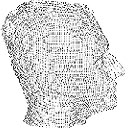 |
Patch Layout Generation
The input point cloud is split into a number of overlapping patches, each defining a connected region of the underlying surface as a scalar displacement field. |
|||||||||
| Raw Patches | 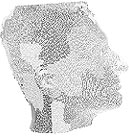 |
Patch Processing Pipeline
First the patch surface is resampled on a regular grid using a fast scattered data approximation (SDA). Then we apply a Discrete Fourier Transform (DFT) to obtain the spectral representation of the patch surface. Using appropriate spectral filters we can directly manipulate the Fourier spectrum to achieve a variety of effects such as de-noising or enhancement. A subsequent inverse DFT reconstructs the filtered patch surface in the spatial domain. |
|
||||||||
| Processed Patches |  |
||||||||||
| Final Surface | 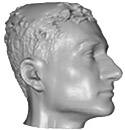 |
Reconstruction
The processed patches are stitched together to yield the final object surface. Overlapping parts of adjacent patches are blended to yield a smooth transition. |
|||||||||
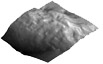


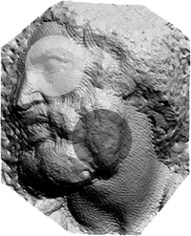
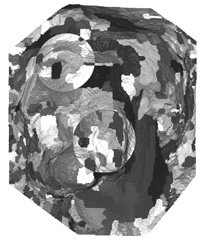
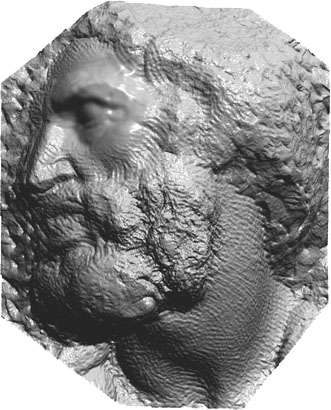
Interactive local filtering operations on the head of the St. Matthew statue. The user can draw a curve on the surface to mark a region of interest (gray circles). The patches are split adaptively at this curve and spectral processing is only applied to those patches within the specified area. This example show Gaussian smoothing around the eye and enhancement on the cheek.
 |
 |
 |
Real imaging systems often introduce some undesirable low-pass filtering, i.e. blurring, since the physical apparatus does not have a perfect delta-function response. Additionally the surface signal is corrupted by high-frequency noise. To restore the object surface in the presence of blur and noise we apply a least-squares optimal filter or Wiener filter. This filter preserves geometric features that are smoothed away by the Gaussian filter.
 |
 |
 |
 |
| Original Noisy Model | Gaussian Smoothing | Wiener Filter | Patch Layout |
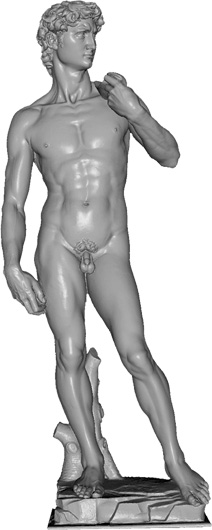
Fourier theory provides a fast adaptive resampling strategy. The idea is to bandlimit the patch surface signal using a low-pass filter. Using the Sampling theorem, an optimal uniform sampling distribution can be determined for each patch surface. The sampling rate adapts to the energy content of the surface, which is closely related to surface curvature. Thus more samples will be concentrated in regions of high curvature, while flat parts of the surface will be covered by fewer samples.
 |
 |
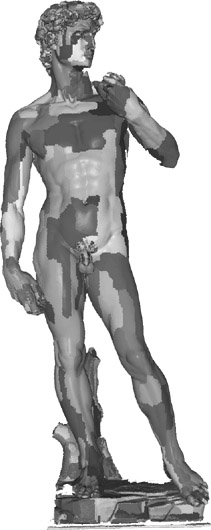 |
| Original: 4,128,614 points = 100% | Subsampled: 287,165 points = 6.7% | Patch Layout |
Using a wavelet transform on the patch surfaces, effective compression of point-sampled objects can be achieved. An area for future research is the implementation of a progressive compression scheme.